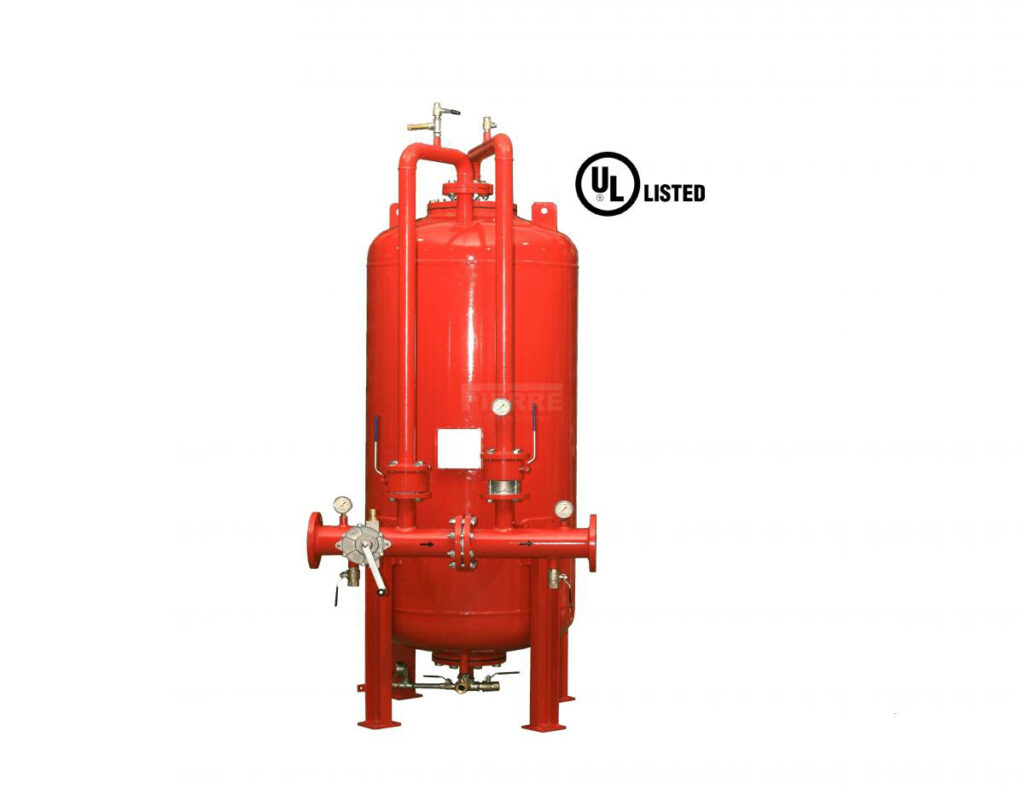
A foam tank, or bladder tank, is basically a large container for storing liquid foam concentrate containing a membrane made of synthetic material resistant to corrosive foaming agents and equipped with a foam dispenser. Depending on where the foam concentrate is contained, it is possible to differentiate as follows:
With Internal Membrane, if the foam concentrate is contained inside the membrane
With External Membrane, if the foam concentrate is outside the membrane, directly touching the wall.
The foam tank serves as a dosing system through a very simple mechanism: water from the water network pressurizes the tank, pushing the foam concentrate contained therein into a venturi-type foam proportioner. Here, the foam concentrate comes into contact with water, forming the foam mixture that will be directed to the distribution network pipe.
A foam tank can have variable dimensions and, consequently, different capacities for storing foam concentrate. It is capable of operating even at relatively low pressures and ensures minimal pressure losses. In addition, the dispenser applied to it can be calibrated depending on the flow rate and the concentration of the mixture required in the system (usually at 1%-3%-6%).
The foam dispenser can be a standard model FI-PM or a wide range type mod. FI-WRM with a huge range between minimum and maximum flow rates, which is commonly used for foam sprinkler systems.